

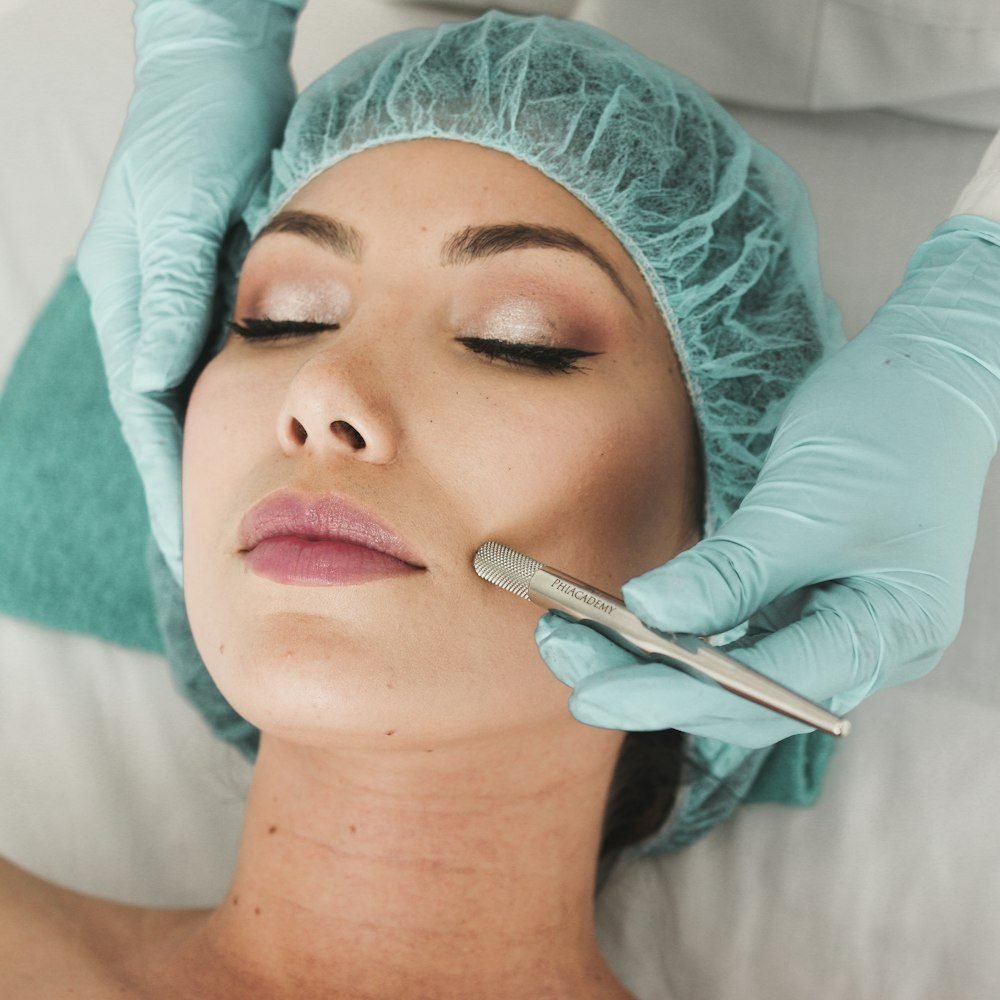

Step One: Double Cleanse & Skin Reading
Every facial begins with a double cleanse to remove makeup, SPF and surface oil, followed by a close reading of your skin under magnification. This determines everything that follows — a congested T-zone gets a different plan to dehydrated, sensitised skin.
The reading is the part clients tend to undervalue and the part that most changes the outcome. Skin behaves differently in different seasons, at different points in a hormonal cycle, and after a fortnight of poor sleep. A facial planned from what your skin was doing three months ago is a facial planned for someone else.
Why The Order Cannot Be Rearranged
Each step prepares the skin for the next one. Cleansing removes the barrier that would otherwise block exfoliation. Exfoliation clears the dead surface layer so extraction is possible without excessive pressure. Extraction empties congestion so that the mask can actually reach the skin rather than sitting on top of it.
When a facial is compressed into thirty minutes, it is this sequence that gets broken, and the result is a treatment that feels pleasant and changes very little. The time is not padding — it is what allows each step to do its job before the next begins.
Step Two: Exfoliation, Matched To You
We choose between enzyme, acid or manual exfoliation depending on that reading. This is the step most home routines get wrong — over-exfoliated skin looks tired and reactive, not radiant, so restraint here matters as much as the treatment itself.
If you are already using a retinoid or a strong acid at home, tell us. We will almost certainly reduce or skip this step entirely, because your skin is already being exfoliated daily and adding a professional layer on top produces irritation rather than results. This is one of the most common causes of a bad reaction to an otherwise well-performed facial.
Step Three: Extractions — Only If Needed
Contrary to popular belief, not every facial needs extractions. We only perform them where congestion will genuinely benefit, using proper steam and pressure technique to avoid the redness and trauma of a rushed extraction.
There is a limit to how much can be safely extracted in one session, and a practitioner who works past that limit is trading a satisfying appointment for a week of inflammation and, occasionally, a permanent mark. If your skin is significantly congested we will clear what we can and ask you back rather than push through in one sitting.
Step Four: The Mask & The Massage
A customised mask addresses your specific concern — brightening, hydration, or calming — while a facial massage, often the most requested part, boosts circulation and gives that unmistakable lit-from-within glow that lasts for days.
The massage is doing more than feeling pleasant. It moves lymph, which is what visibly reduces puffiness around the eyes and jaw, and the effect on the face is usually more noticeable the following morning than it is immediately afterwards.
Step Five: Protect
Freshly exfoliated skin is temporarily more vulnerable to UV, so every facial closes with a broad-spectrum SPF regardless of the weather or the season. This is not an upsell and it is not optional — skipping it on a grey afternoon in November undoes a meaningful part of what the appointment achieved.
Afterwards: The 48 Hours That Matter
Leave the skin alone. No retinoids, no acids, no scrubs and no new products for two days. Avoid heavy exercise, saunas and very hot showers on the day itself, since heat and sweat on freshly extracted skin is the most reliable way to provoke a breakout that the facial would otherwise have prevented.
A small number of clients experience purging in the following week, particularly after a first facial. Congestion that was already forming beneath the surface has simply been brought up faster. It settles, and it is a different thing from a reaction — but tell us either way, because it changes what we do next time.
How Often Is Actually Useful
Skin turns over roughly every four weeks, so a cycle of three to four weeks is where results genuinely compound. Monthly for the first three months if you are addressing something specific, then every six to eight weeks to maintain it, is the pattern that works for most people.
One facial before an event will leave you looking rested and glowing. It will not resolve pigmentation, texture or persistent congestion, and any practitioner who tells you otherwise is selling rather than treating.