

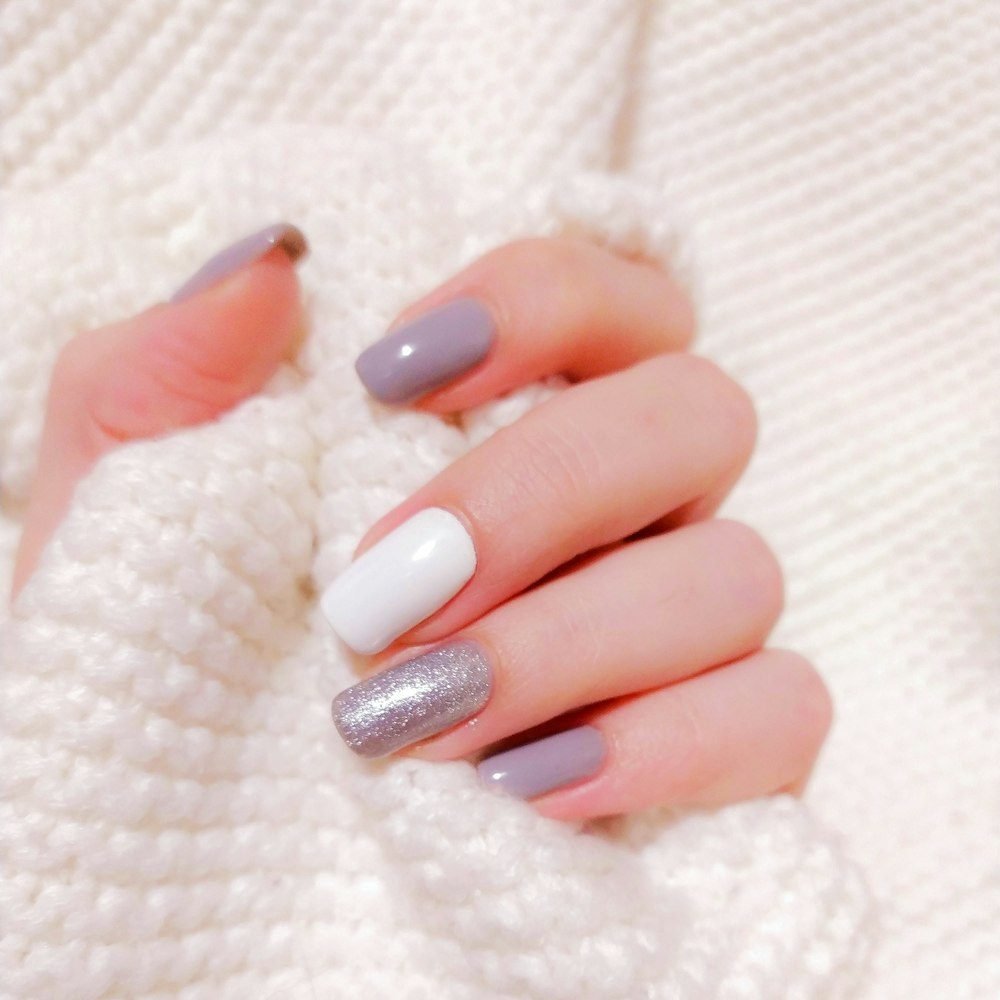

Glazed Chrome
A milky, semi-sheer chrome finish that catches light without looking loud — currently our single most-requested look, and one that flatters every skin tone.
The effect depends almost entirely on what sits underneath. A warm, sheer base gives the soft pearlescent finish most people are actually asking for, while a cooler base pushes it towards silver and reads far more metallic. Bring a photograph, because the same chrome powder can produce two quite different results depending on the base beneath it.
Micro French
The classic French tip, redrawn with a hair-thin line instead of the traditional bold white edge. Pairs beautifully with an almond or soft square shape.
It is far more technical than it looks. A line that thin shows every inconsistency in the smile line, and it needs a steady freehand rather than a guide. It also grows out more gracefully than a traditional French, because there is simply less white to separate from the cuticle as the nail moves forward.
Textured Accent Nails
One nail per hand in a matte or textured finish against an otherwise glossy set — a subtle way to add dimension without full nail art.
Matte finishes do mark more easily than glossy ones, particularly with hand cream and oils, so if you work with your hands consider putting the accent on the ring finger rather than the index, where it will take considerably less contact.
Soft Neutrals With Depth
The other consistent request this season is for neutrals that are not flat — greige, warm taupe, and milky beiges with a hint of pink beneath. They photograph far better than a plain nude, which tends to disappear against the skin and can make fingers look shorter.
Choosing A Shape That Suits Your Hands
Almond elongates and is the most forgiving on shorter nail beds. Soft square is the most durable and the best choice if you type all day or work with your hands. A true stiletto looks striking and breaks constantly on anyone with a job.
Your natural nail shape matters more than the trend. Working with the curve of your own nail bed produces a set that grows out evenly; fighting it produces one that looks wrong within a fortnight and is more prone to lifting at the sides.
Making It Last
Whatever the finish, longevity comes down to prep: proper cuticle work, dehydrating the nail plate, and a quality base coat matter more than the top coat you finish with. Ask your nail artist for a gel system if you need your set to survive two to three weeks untouched.
At home, the single most useful habit is cuticle oil daily. Oil keeps the nail plate flexible, and a flexible nail bends where a dry one chips. The second is wearing gloves for washing up — prolonged hot water is the most common reason a gel set lifts at the edges a week earlier than it should.
And Please Don't Pick It Off
Removing gel by peeling takes layers of the natural nail plate with it, and the thinning is cumulative. If a set has outgrown itself, book a removal — it takes fifteen minutes, costs very little, and is the difference between nails that recover between sets and nails that get progressively weaker all year.
How Long Between Sets
Two to three weeks is the honest window for gel on most people. By week four the regrowth at the cuticle is visible enough that the set stops looking deliberate, and the leverage on the free edge makes lifting far more likely.
If you wear gel continuously, it is worth taking a week off every few months and wearing a strengthener instead. The nail plate does not need to breathe — that particular myth is not true — but the removal process itself is mildly abrasive, and spacing it out lets the surface even out again. Clients who do this consistently have noticeably better nails a year later than those who never take a break.